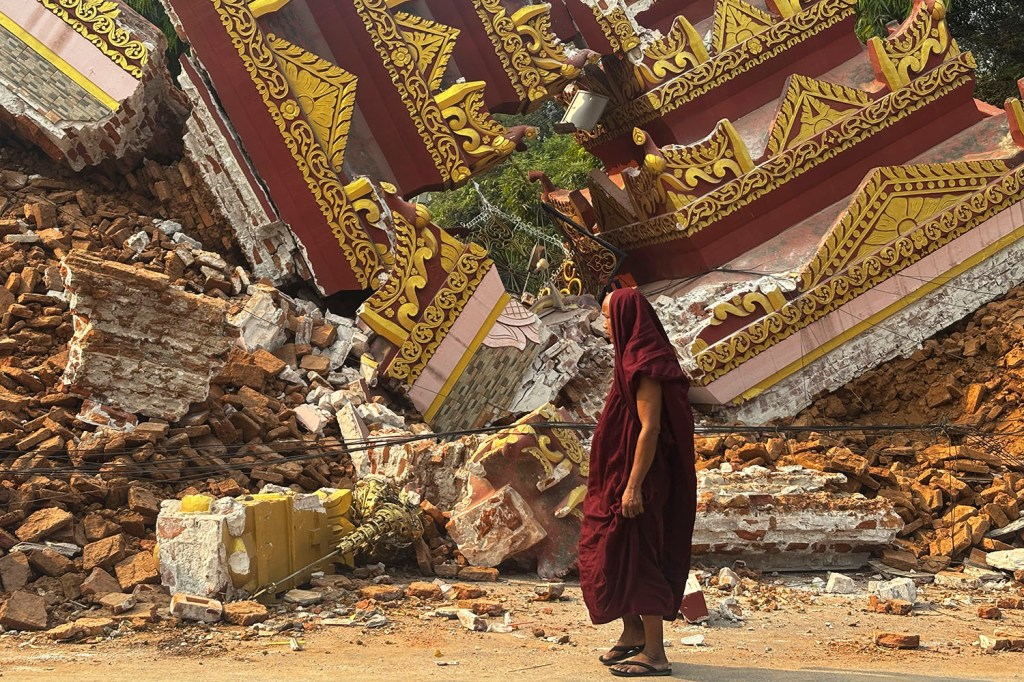
Hello everyone, thank you for following along. I apologize for my irregular posts lately. To catch you up, many things have happened: the earthquake, moving from Don Mueang to Ayutthaya, dealing with Bangkok Belly, and a visa run. I’ve had little time to write. I’m still working on my cultural orientation week and have some interesting topics planned, but I’ve faced some challenges. I hope to write a little more consistently over the course of the next few weeks.
So, getting on with it, I want to write a little bit more about the Earthquake. The geology of Bangkok and its surrounding area is made up of “mud,” which I’m assuming means clay and silt; placing the city right in the middle of a giant bowl of jello. This unique geological composition affects how seismic waves travel through the ground, amplifying the vibrations that the city experiences during an earthquake. Because the soil mechanics and geology of my region of Thailand are different from Bangkok, it explains why I experienced the earthquake differently than other parts of the country.
The 7.7 earthquake that hit Myanmar caused a 6.5-6.6 earthquake in Bangkok. By now, I’m sure you’ve seen all the footage of buildings in Bangkok losing all the pool water from their rooftop pools and the building that collapsed. However, Thailand and Bangkok both came through the earthquake that happened on March 28th with flying colors, albeit a little bruised. Infrastructure in Bangkok is hardy. The airport, rail system, communications, power, water, sewer, and gas were all back up and running almost immediately after the quake. There were a few roads in Bangkok that suffered some damage, but those repairs are underway, if they haven’t already been fixed. When I went through Bangkok on Wednesday, I saw very little damage, if any. It speaks to the resilience of the city and how well-made the buildings are. Buildings in Bangkok behaved exactly as they were designed to. Granted, many of those high-rise buildings have a lot of cracked drywall panels in them now that will need to be replaced or repaired, but overall, the buildings are structurally sound. Skybridges on several of the buildings will need to be repaired, but that’s also to be expected. Again, a minor issue considering what happened.
However, lives were lost in the earthquake that hit Bangkok. The last count that I saw indicated close to 100 people were killed in the earthquake. Most of those souls were working on the building that collapsed. While the Thai government has launched an investigation into the building collapse, I want to point out what I know the facts are and offer a speculative opinion. First, the facts: the building construction was being overseen by the China Railway Company and managed by the Italian-Thai Development Company. Construction on the building began back in 2020 and has cost 63 million USD, so far. The building was 33 stories tall and being fitted with all of it’s internal structures at the time of the collapse. Israel sent equipment and the United States sent personnel to help search for survivors. My speculation is the building had not received all of its earthquake proofing yet. Although, bad batches of concrete, or inconsistent pourings may have contributed as well. Again, I can’t overstate that this is my own speculation at the moment. There’s a lot of work to do yet.
Bangkok is a hearty town. In the grand scheme of things, it’s going to recover quickly from this incident. Myanmar, on the other hand, is a different matter. Entire buildings have collapsed, roads destroyed, and in some places, will probably never come back. The city impacted the greatest was Mandalay. It’s the second largest city in Myanmar, and is the heart of Buddhism in Myanmar. Reuter’s reported that at least 14 monks were trapped in a monastery that collapsed. Further out, three Muslims were trapped in a mosque that collapsed. The city is also facing extra challenges because roads and bridges across the country have collapsed, making aid and rescue efforts even more difficult to perform.
The earthquake couldn’t have come at a worse time for all the citizens of Myanmar, and the refugees that are living along the border with Thailand. Myanmar is not only fighting a civil war, where the military junta has overthrown the democratically elected government (thus the refugees living along the border with Thailand), but it’s also fighting a war with Thailand too. As the Red Cross has eloquently stated, this is a complex humanitarian crisis.
The leader of Myanmar has reached out to all nations asking for aid in recovery from the earthquake. President Trump has said the US will send help, food, potable water, and disaster relief through USAID. China is also stepping up to help, along with other nations from around the world. However, there is still much more to be done. If you would like to donate, I found a handy blog that tracks charities involved with the efforts that are among the best at working to provide relief. I’ve donated; please consider making a donation yourself.
Another great organization out on the front lines helping to ease the humanitarian crisis unfolding in Myanmar is the World Central Kitchen. Food is central to all of us, and the people there especially need help. https://donate.wck.org/give/677238/#!/donation/checkout?c_src=2025-site-slider-myanmar
Thank you again for following along and for continuing to support me on my journey through Thailand and the rest of the world. I’ll be getting back to regular content shortly. Until then, please take care of yourself, look out for each other, and stay curious.
-image credit: Thein Zaw/AP


Leave a comment