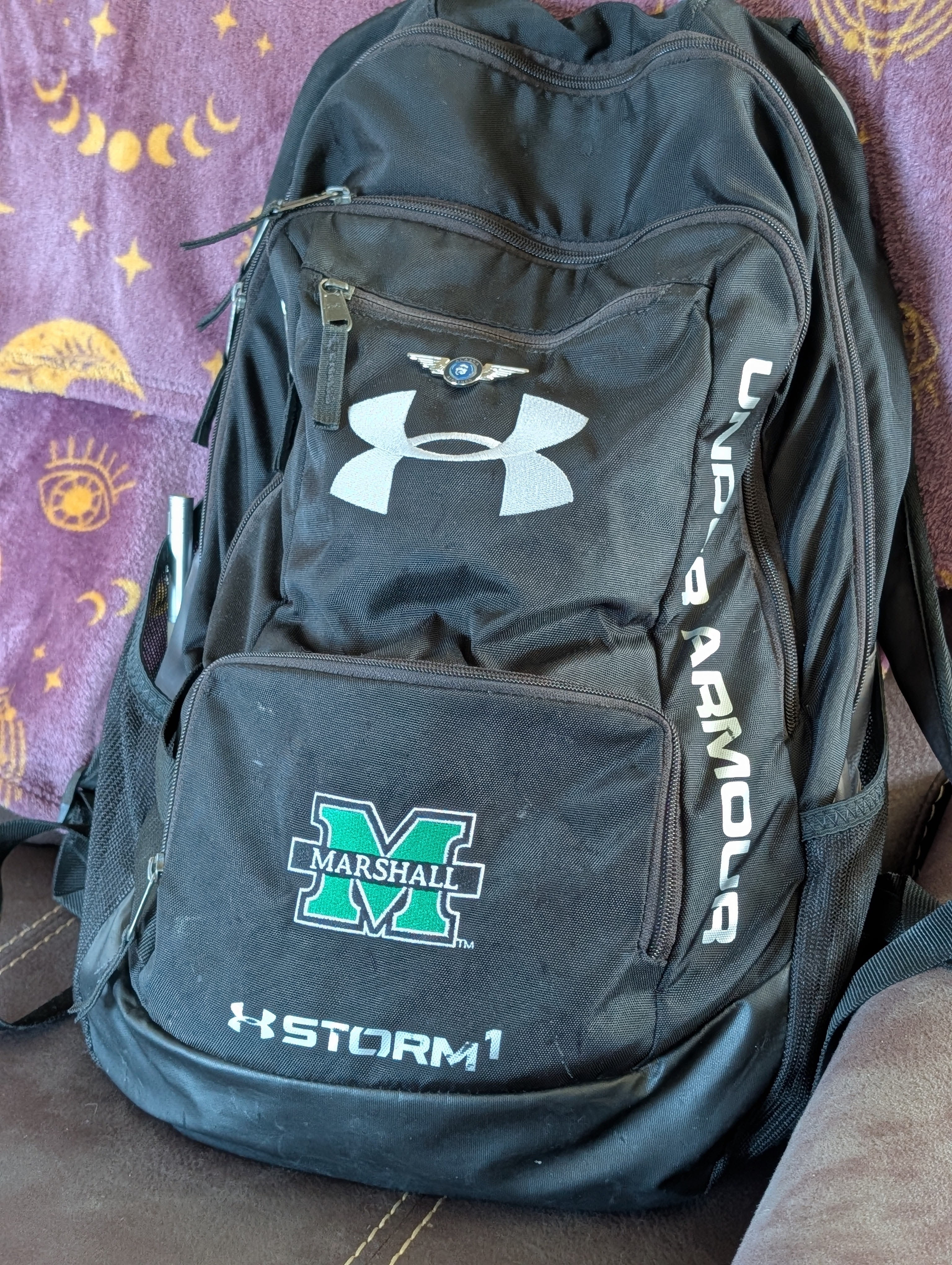

So, to pick up where we left off, my partner and I, travel‑weary down to our bones, got off the train and started wheeling our luggage toward the hotel, excited to collapse in bed like two player characters who had just survived a boss‑level airport dungeon and desperately needed a save point. That’s when my brain tapped me on the shoulder and whispered, “Hey, buddy… where’s your bag?”
I’m pretty sure my soul left my body with the full force of a crash‑test dummy hitting a brick wall with that realization. “Fuck!!!” I blurted. “My bag! It’s gone!”
That bag held my life together. It had my laptop, tablet, phone, earbuds, wallet, keys, meds, charging cables, adapters, fountain pens, journal, book, power banks, screwdrivers (which will be problematic later)… everything. All told, that’s like $3k worth of stuff — gone! That black Marshall University bag that had carried me through a decade of life and never once failed me… gone! I had never failed on this scale before.
The bone‑deep exhaustion evaporated instantly, replaced by pure adrenaline. Fortunately, age and wisdom kicked in before panic fully took the wheel. I turned to my partner and said, “We have to go back.” I gave her the option of taking the luggage and heading to the hotel, but because she’s the most supportive human being I know, she chose to come with me rather than try to check in alone.
That made sense. The hotel was under my name, and they’d need my passport. Then it hit me.
“Fuck!!! My passport!” It was in my bag, too.
The fear really started to set in at that revelation. How was I supposed to get back to the U.S. without it? For that matter, I didn’t even know where the nearest U.S. consulate was, because in no catastrophic scenario I had ever planned for did I think I’d forget the most sacred of travel objects.
Luckily, we hadn’t gotten far from the station. We hobbled back with our luggage in tow, and I walked up to the counter. I reached for my phone to pull up my translator app… and remembered my phone was also in the bag… ’sonofa….’
Sigh. How do you explain this to someone who doesn’t speak your language? That you’re an idiot who left their life on the train, and hopefully nobody else has already claimed it! Interpretive dance, perhaps? That is a great thought experiment, but not one you want to have to contemplate in real time.
The station agent was a kind‑looking older man who watched me attempt to communicate through a combination of non-existent Japanese and interpretive dance. He stopped me, smiled, and came out from behind the counter with a translator device. He looked exactly like a night‑shift station master should: kind face, reading glasses, visor, and the most iconic Japanese accessory — slippers.
I explained what happened, and the device translated it into Japanese. He asked me to describe the bag and which car we’d been riding in. I told him we had reserved seats in Car 4. He asked where we were headed. I explained our ticket was for Otaru Station.
He nodded, thanked me, and made a phone call.
Three minutes later, he hung up and told me they had called ahead of the train and contacted the agent at Otaru Station. They said they’d have an agent board the train, retrieve my bag when it stopped there. He also confirmed with the conductor on the train that the bag was there. He even explained where to go to retrieve it.
I thanked him profusely in the little Japanese I know, bowed far more than necessary, and walked over to the kiosk to buy tickets. Except… I couldn’t. Because my wallet — with all my cash — was in the bag.
So, I walked back to the station agent, smiling sheepishly. He smiled back, already reaching for the translator. I explained the situation. My partner stepped in, pulled out her wallet, handed over her credit card, and bought our tickets. The old man nodded, processed the tickets, and sent us on our way.
While we waited for the train, my partner and I talked. I was beside myself — shaken, embarrassed, relieved, terrified.
“I can’t believe I did that,” I said.
She smiled gently. “It could happen to anyone. Don’t be too hard on yourself.”
I smiled back, but I knew I was angry at myself. “That could have gone sideways and left us stranded in a very ugly predicament. It was irresponsible of me. I’m sorry.”
“We’re both tired, and accidents happen,” she said, nudging me. “Besides, what do we always say when faced with challenges along the road of life? ‘I don’t know, but we’ll figure it out.’” She smiled, and it made the world better.
I squeezed her hand. She was right. That really is the mantra of our relationship, and at our core, who we are. From the beginning, we’ve had to ask tough questions about who we are and what we’re doing, and through it all, we’ve always said, “I don’t know, but we’ll figure it out.” And we always have.
Just then, the train arrived. I grabbed both suitcases, and we boarded. Two stops later, we were at Otaru Station, standing in front of the station agent’s desk. This agent was younger. He pulled out his translator, and I explained I was there to retrieve my bag.
He looked at me, smiled, and asked, “You’re Scott‑san, yes?”
I laughed. “Yes.”
He reached behind him, picked my bag down from the counter, and handed it to me.
Instantly, I started crying. The relief of having my bag back — and by proxy, my identity, my lifeline, everything I needed to function — washed over me. Everything was intact, down to the assorted receipts in the outer pocket. I thanked the agent, bowed, and he bowed back before returning to his work.
We walked outside the station. I was relieved, but now we had to get back to the hotel. As much as I love efficient public transportation, I was overwhelmed. Exhaustion had returned with a vengeance, and rational thought had left the building. My partner saw it immediately.
Despite her own exhaustion, she stepped up. She put her arm around me and said, “I’m thirsty. Why don’t you go into the 7‑11 and get us some water, and I’ll hail a cab?” She shines in moments like this. When the world feels like it’s falling apart, she can shoulder it as few people I know can.
So, I went into the 7‑11, which under normal circumstances is one of those quintessential Asian experiences everyone should have at least once. I bought what I thought were two bottles of water, thanked the clerk, bowed, and walked back outside. A taxi had just arrived. My partner was getting in. The driver hopped out, loaded our luggage, and we were off.
We both opened our bottles for a swig… only to discover that the “water” I grabbed was something resembling water on paper. It tasted like someone whispered the name of a fruit from another room — but with saccharin. Way too much saccharin. We choked it down because we were thirsty. My partner gave me a sideways look that said, “You’re trying to kill me.”
To keep things light, I decided to engage our cab driver. Since I had my phone again, I typed a thank‑you message and held it up for him. He lit up, turned around, and said, “Thank you!” in English. He was thrilled to practice his English. As he said, he never gets the chance to speak it anymore. It turns out he’d spent time abroad but came back home when his family needed him, and thus he became a cab driver. We never saw him again, but he was a bright spot on a chaotic night. I hope he’s doing well.
We arrived at the hotel. The lobby was gorgeous — reminiscent of the golden age of travel, when hotels had patrons, and bellhops in full uniform knew them by their names. Clean lines, warm lighting, a touch of 1930s glamour without the Depression‑era gloom. The clerk greeted us, checked us in (requiring my passport — thank you, universe), handed us our keys, and told us when breakfast was.
We rode the elevator up, opened the door to our room, stripped down, flung clothes and bags everywhere, and collapsed on the bed — asleep before our heads even hit the pillows.

The Next Morning
I woke up first. I made coffee and opened the curtains. The sun was just starting to rise, and our room overlooked Otaru’s port and the Wing Bay. We got a perfect view of the sunrise — our first real one in Asia. The sun had beaten us to Taipei, so we missed that one.
There’s something about sunrises on this side of the Pacific that makes them unforgettable. The sky shifts from black to deep blue, then, just as the sun nudges the horizon, it erupts into fire. Reds, oranges, golds, and faint lines of green. And in that brief moment before the sun emerges, the entire spectrum of the rainbow explodes across the eastern sky. It’s a religious experience.
I’d only seen it twice before: once landing in Hong Kong, and once on a beach in Hua Hin, Thailand. Sunrises in Asia are special, but this was its own moment of glory. As much as I wanted to wake my partner to share it, I let her sleep. I pulled a chair to the window, sat down with my coffee, and watched the sky perform its quiet miracle. This moment was mine — a chance to reflect on everything that had brought me here.
For most of my life, I felt stuck and out of place. I was the kid raised on Indiana Jones movies and Allan Quatermain novels. I dreamed of exploring the world. I didn’t want the Nazis or the villains in King Solomon’s Mines, just the adventure. Utica, Ohio, might be a lovely little town, but it wasn’t Cairo, Venice, or London. It seemed as if whatever life of adventure I was to have wouldn’t take me far outside of Licking County, and I had to make peace with that.
So when a recruiter came to my high school talking about becoming a foreign exchange student, I was electrified. I couldn’t wait to tell my mom. If there was anyone who understood that need, it would be her.
When I got home that night and sat at the kitchen table having dinner with my mom, I told her all about becoming a foreign exchange student and that I really wanted to do the program. She sat in silence, listening to me. I could tell she hated the idea. She talked it down, saying I really didn’t want to do that. However, I persisted. I knew a worldly life was for me. Mom was having none of it. She shut down the conversation by directing me to ask my father. If he approved, they would figure it out. My heart sank. I knew what that answer was going to be, but I was also my mother’s son — endlessly stubborn and optimistic to a fault. So, I stayed up that night and waited for Dad to get home from work.
Dealing with Dad required a level of finesse that Mom did not need. So, I waited for the opportune moment and asked what he thought about me becoming a foreign exchange student. He asked me where I wanted to go, and I had to stop and think about that for a minute. The real answer was everywhere first, Japan second. However, I knew neither of those answers was acceptable. Dad always required justification for why something was important rather than just accepting that it was, and I couldn’t articulate why it was important to my 15‑year‑old boy soul.
I sat and thought about it for a second. In my silence, I heard my grandmother’s voice loud and clear. “Germany,” is what I told him. My grandmother was born in the old Austro‑Hungarian Empire before WWI and immigrated to America shortly before the war started. She always spoke fondly of the old country and liked parts of Ohio because it reminded her of her home in the rolling hills of Austria. Dad, however, served in the army during the Vietnam War and was stationed in West Germany for his tour of service, so he had a very different view of Germany.
He always spoke favorably of his time there and in the service, so I had some hope this could become a “yes” moment. However, Dad, being Dad, knew how to shut down conversation in a very different way from Mom. He told me that if I wanted to go, then I would need to figure out a way to pay for it. If I could do that, he’d support me. My heart dropped. I was a 15‑year‑old boy looking at a sheet of paper that indicated this was likely going to have a price tag of at least a couple of thousand dollars — more than a kid growing up on the outskirts of farm country would be able to come up with without some sort of parental support. I resigned myself to the fact that this was a pipe dream, went to bed, heartbroken. My dream, so it would seem, would just have to wait, if it would ever come at all.
And now, here I was, decades later, watching the sun come up over the Land of the Rising Sun. Poetry in motion. Needless to say, I hadn’t become a foreign exchange student in life, but I had found my way here, to this moment, in Japan.
How lucky am I?
Few people ever get to fulfill their life dreams. And here I was, in all my glory, drinking coffee, watching the sun come up over the Wing Bay from my hotel room on the 11th floor, watching the harbor wake with the light. It was glorious. I felt humble, proud, vulnerable, and at peace. For what felt like the first time in my life, I was exactly where I was supposed to be — fully in the moment, in my body, connected with my soul in a place the universe meant for me to see.
My partner stirred awake, and the moment shifted. I made her a cup of coffee and brought it to her in bed as she woke up, just in time for her to witness the last bit of the golden hour on our first day in Japan. It seems that the universe wanted her to see this fleeting moment as well.
I am a lucky man, indeed.


Leave a Reply