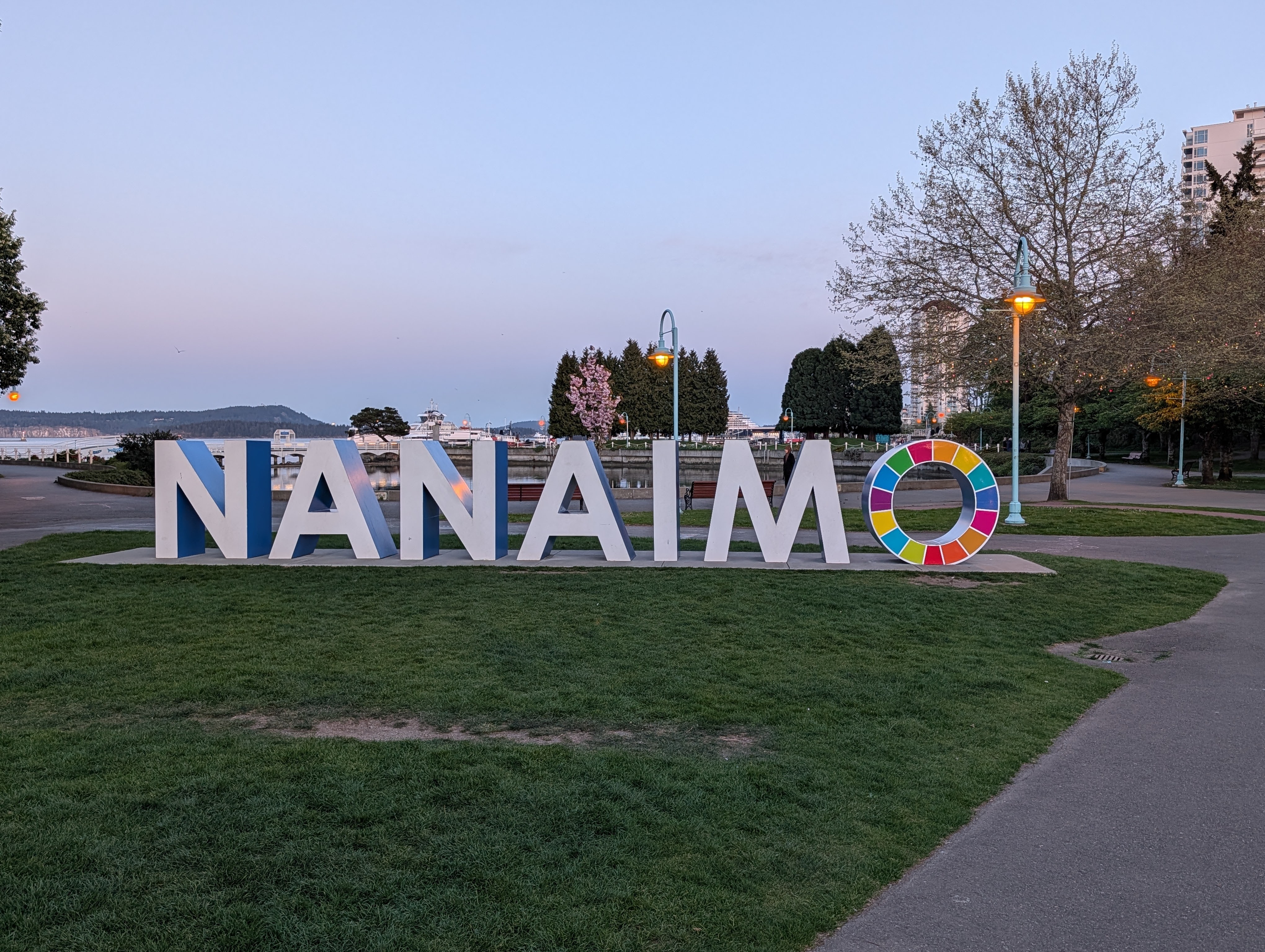
What a Healthcare Event in Nanaimo, B.C., Revealed About Two Nations

This last weekend, my partner and I took a trip up to the beautiful Sunshine Coast of Vancouver Island for Tod Maffin’s Nanaimo Infusion. Tod is a Canadian journalist who has spent time on the internet as America’s emotional support Canadian, a role he has excelled at. The goal of the Infusion was to bring Americans and Canadians together to celebrate our common humanity and connect American healthcare workers to Canadian recruiters.
Disclaimer
I’m going to say some things here that may offend certain demographics of the American population. My intention is not to offend, but to hold up a mirror to our society. If you are offended, then it is time to reflect on the image you see in the mirror.
So, here’s what I can tell you.
Canadians Really Are That Nice.

From the moment we lined up on the ferry to the moment we were back in the U.S., almost every single Canadian we spoke with was happy to see us and understood that we’re going through some things in America right now. Conversations were easy, people were quiet but also disarming. Everywhere we went, people were unguarded, and the kindness we felt wasn’t transactional.
One night, we went out to a Greek restaurant in the Old City Quarter district. It’s the sort of establishment that feels like it didn’t start out as a restaurant, but that’s what it morphed into. The waitstaff was amazing, and even the owner made sure to come around to every one of his tables and speak with his patrons. The food was simply divine. When the owner got to our table, I told him that I hadn’t had moussaka in close to a decade and that his was the best I’d ever had. I shook his hand and told him we were happy to be there.


As we were paying our bill, two shots of ouzo came out to us, on the house. While I can’t confirm it, we suspect the owner quietly sent them our way. The shots were delicious, powerful, and a quick reminder that we were seen and welcomed.
Everyone we met was kind and wanted to know our stories, especially at the actual Infusion event. As a treat for me, I got to listen to a lot of different stories as well. Some folks were Nanaimo natives, some had moved to B.C. from different provinces, and some were wayward Americans who had found their home in Canada. All of them had a keen interest in their communities and in looking out for their neighbors, including us Americans.
To everyone’s surprise, B.C.’s Premier came out to speak and said that this event showed disputes happen between governments, not people, and that we will get through this together. I haven’t heard anything remotely that encouraging since the start of the Trump administration. It was refreshing and beautiful, all at the same time. The consensus I found was that everyone still holds Americans in high regard, more or less, but despises our current administration—and that’s fair.
Which brings me to:
Americans Are Strung Out.
First and foremost, all the Americans we met were strung out and shellshocked. Most were healthcare workers, nurses, professionals, and people from marginalized communities. I met a young woman from Cleveland who simply couldn’t fathom what it was like to be in a public space and not fear for your life. She was crying because all the Canadians in the park were genuinely happy to see her and were glad that she was there.
She marveled at the people and families in the park who were just hanging out. Children were playing on the playground, adults were walking along seaside trails, and nowhere was there a sense of fear, urgency, or reluctance. It was just people milling about and having a night out. This was her first time having that experience.
If I had to guess, she was young enough that she doesn’t have any memory of an America where people just go to the park to hang out and relax, and where kids get to run free. I remember that America. It wasn’t that long ago when kids still walked to school by themselves and hung out on the playground without adults constantly hovering over them. We don’t do public spaces anymore, and children, by and large, do not go outside to play.
This change in America has been slow enough that many people aren’t cognizant of it until they experience life abroad, or until they’ve been in parks so neglected that you wouldn’t feel safe just sitting there, never mind allowing your children to run free and have their own unsupervised Lord of the Flies time with their play pals.
The people who came are deeply concerned about their own safety and welfare in America right now. Some were gay, some were Black, and a few were even there on asylum claims. I cannot overstate how shocking that was to hear, but that’s also the reality many Americans are finding themselves in. Regardless, these are young people who grew up performing active-shooter drills and feel the U.S. government doesn’t care about education, safety, or their well-being, and they’re right.
One woman I spoke with informed me that the “professional” category of her degree was removed by the Department of Education, making future employment more difficult and delegitimizing the education she did receive. She’s worked in healthcare for years, but that could be in jeopardy because of the administration’s attempt to “rein in” student loan borrowing. Canada has a pathway for her.
A Crisis On Both Sides
Here’s the thing: both Canada and the United States are in crisis, and I want to talk about one specific area where both nations are struggling—healthcare.
The Nanaimo Infusion didn’t just happen. Canada has serious shortcomings in its healthcare system, not in the quality of care, but in the shortage of supply. At the same time, the United States is also experiencing a healthcare crisis, with the biggest issue being access to care via health insurance. Both of these crises are self-induced, and the end result is the same: people are dying while waiting for the care they need.
The difference is how the two countries are responding. Canada is actively recruiting healthcare professionals, and by all appearances, it’s working. Over a thousand Americans showed up for the recruiting event in Nanaimo. The model has been so successful in recruiting healthcare workers that other cities across Canada are actively creating their own Infusion events to replicate its success.
Meanwhile, the U.S. approach to healthcare is to continue down the path of a market-based solution. So far, what that has produced is increased insurance premiums, denied claims, patients not receiving the care their doctor is prescribing, and higher burdens are being placed on policyholders, resulting in medical bankruptcy. So, what is the point of insurance if that insurance is functionally useless?
Who will have better health outcomes ten years from now? It’s hard to say—but my money is not on the U.S. We already have some of the lowest health outcomes in the industrialized world, with our average life expectancy dropping steadily, and since we’re not addressing it, that’s not likely to change anytime soon.
At the end of the day, this is a tale of two countries that have chosen very different paths. Canada has decided to live up to the ideals of America as written by Emma Lazarus, The New Colossus, while the United States is turning its back on them. As someone who studies history, holds an advanced degree in the field, and understands pattern recognition in systems, it’s painful to watch my country go down this path of suicide.
On A Positive Note
Still, I want to end on something hopeful. Americans are hurting. Those who showed up in Nanaimo are questioning America’s future and their place in it. They feel targeted, and as someone who has voted against Donald Trump three times, I get it; I have been targeted too.
So, when the event organizers stated that it doesn’t matter who you are, if you are gay, or have trans-kids, all are welcome in Canada, I can’t adequately describe what I felt after hearing that. It gave me a sense of longing for home that I’ve rarely experienced anywhere in my life.
But the moment that stayed with me most was hearing about a man from Victoria who brought his kids to the event as a teachable moment. America isn’t seen in the best light on the world stage right now. In some cases, Americans are painted as monsters because a majority of us chose this path. It wasn’t forced; it was intentional. Go to any corner of your favorite social media app, and that monster element is present. So, he wanted his kids to see that we’re all human, and that Americans are not people to be feared—even if America, right now, is a scary place.
If you’ve ever been branded an outsider, an “other,” or some kind of misfit, then you know what it feels like to be ostracized, to live in silence, and to constantly look over your shoulder. I’ve lived with that feeling for most of my life. So, hearing a father tell his children to interact with Americans and learn that we’re just people felt especially raw and tender.
There were no politics or slogans; just a lesson that the people on the other side of the border are nothing to be afraid of; they’re simply neighbors they haven’t met yet.
That moment stayed with me because it was the culmination of everything I felt all weekend. The kindness, safety, and calm curiosity we experienced have been reaffirmed across generations, and that feels wholesome and distinctly Canadian. That choice made Nanaimo and Canada feel comfortable, like your favorite shirt, and if only for a moment, it reminded me again of what home should feel like.
I’ve been thinking about that—a lot.
I am grateful to the community of Nanaimo, the communities of Vancouver Island, and Canada for reminding me of what normal is. I see you, I got you, and I hope to be a part of that, please.


Leave a Reply